
May 15, 2026
Today has been a wild day, and so far my most favorite day of the trip.
So woke up this morning in Arequipa, early since I was anticipating 8-10 hours of hopping multiple colectivos to get here. Turns out in spite of saying they have 24 hour reception the hotel I was staying at in Arequipa does not have 24 hour reception. Also, they lock the front door. So I ended up being unable to check out or leave at the time I wanted. Thankfully when they finally did show up so I could check out I was only an hour behind schedule.
Uber got me to the spot to get a colectivo to Chivay a lot faster than I expected, I had a shorter wait than expected before the colectivo departed, and I had absolutely no wait transfering to a colectivo here to Cabanaconde. Plus both colectivos made their respective drives faster than anticipated. I ended up getting here much earlier than I expected. Rather than 8-10 hours it took 6.
The drive from Arequipa to Chivay goes through increasingly higher deserts and passes a number of volcanoes.
No idea offhand what volcano that is. Pictures are geotagged, so I’ll look it up eventually.
The road also passes through an area that is home to herds of vicuñas.
There are four camelid species in the Andes. Llamas, alpacas, Guanacos, and vicuñas. Llamas are domesticated guanacos, and alpacas are domesticated vicuñas. Vicuñas are notable in that their hair fibers are the finest and smoothest of nearly all fibers. Only silk is finer. Consequently, their wool is the most expensive wool on the planet. They’re also technically endangered, and their wool is subject to some pretty stringent export regulations. But, because the wool is renewable, and there’s historical precedent for its harvest (the Inca harvested vicuña wool), it is allowed. But, I’m technically not in the socioeconomic stratus to be plopping down $4000 for a vicuña scarf or $35000 on a vicuña sweater.
The road keeps on climbing higher and higher. Eventually crosses a pass at 16,000 feet above sea level before dropping back down to 12,000 at Chivay.
The pass is covered with carnes as far as the eye can see in either direction. My understanding is they were placed originally by the Wari, who predated the Inca, and the Inca added to them (as I’m sure people in the modern era have as well)
Eventually we dropped down to Chivay, which is the gateway to the upper Colca valley. I wasn’t in Chivay more than 5 minutes, but I head back there tomorrow for a several day stay.
From Chivay we went down the upper Colca valley towards the colca canyon here at Cabanaconde.
I wasn’t not at all expecting the Colca valley to be as beautiful as it is.
The road from there to here has some stretches that are “paved”, but it also has long stretches that are one lane rutted dirt road. And my ass was literally hanging out the back window of the colectivo trying to take pictures. Very few of them really turned out, but as an example.
I’m definitely going to be a shutterbug as I explore around Chivay, so there’ll be more pictures.
Cabanaconde really threw me for a delightful surprise. When I arrived around 1pm there was a festival going (it’s still going and it’s currently 830pm). No idea what the festival is about. This is probably the most rural town I’ve been to in Peru. It extends maybe 2-3 blocks in every direction from the Plaza de Armas. Population of maybe 150 people. I am absolutely the only non local here, which surprised me. This place is the gateway to the colca canyon, which is definitely a trekking destination. But I’m getting the feeling that the kind of people who actually trek into the canyon hire tour companies from Arequipa who bring them up here and straight down into the canyon. So gringos don’t really show up on their own and stay in town. I definitely wouldn’t have been able to come here a year ago with my complete lack of Spanish. Nobody speaks English. But I seem to be doing alright this time.
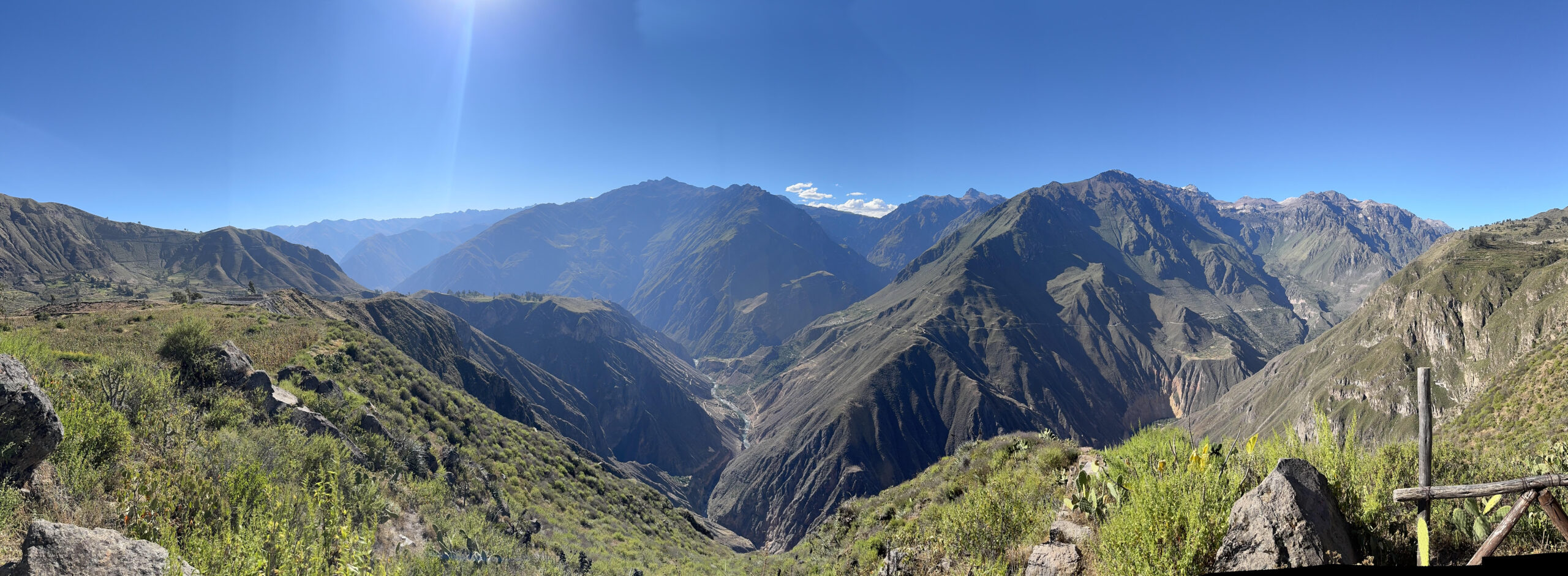
I did do about 3 hours of hiking when I got here. Went to various viewpoints overlooking the canyon.
It’s allegedly the second deepest canyon on earth. Only beat by a canyon through the Himalayas between Tibet and Nepal.
When I came back to town I just hung out and watched the festival.
Eventually after sunset everybody congregated around the church and have been dancing to the band and having a great time.
I sat off to the side and watched, but eventually one of the women in her indigenous finery walked over to me and said “baila conmigo”. Fortunately I have enough Spanish that I know what that means. So I ended up dancing with them for a while. Again, no idea what they’re celebrating. But it was definitely one of those unexpected life experiences that becomes a treasured moment of the trip.

